Claude Code 10x vs Claude Code 100x
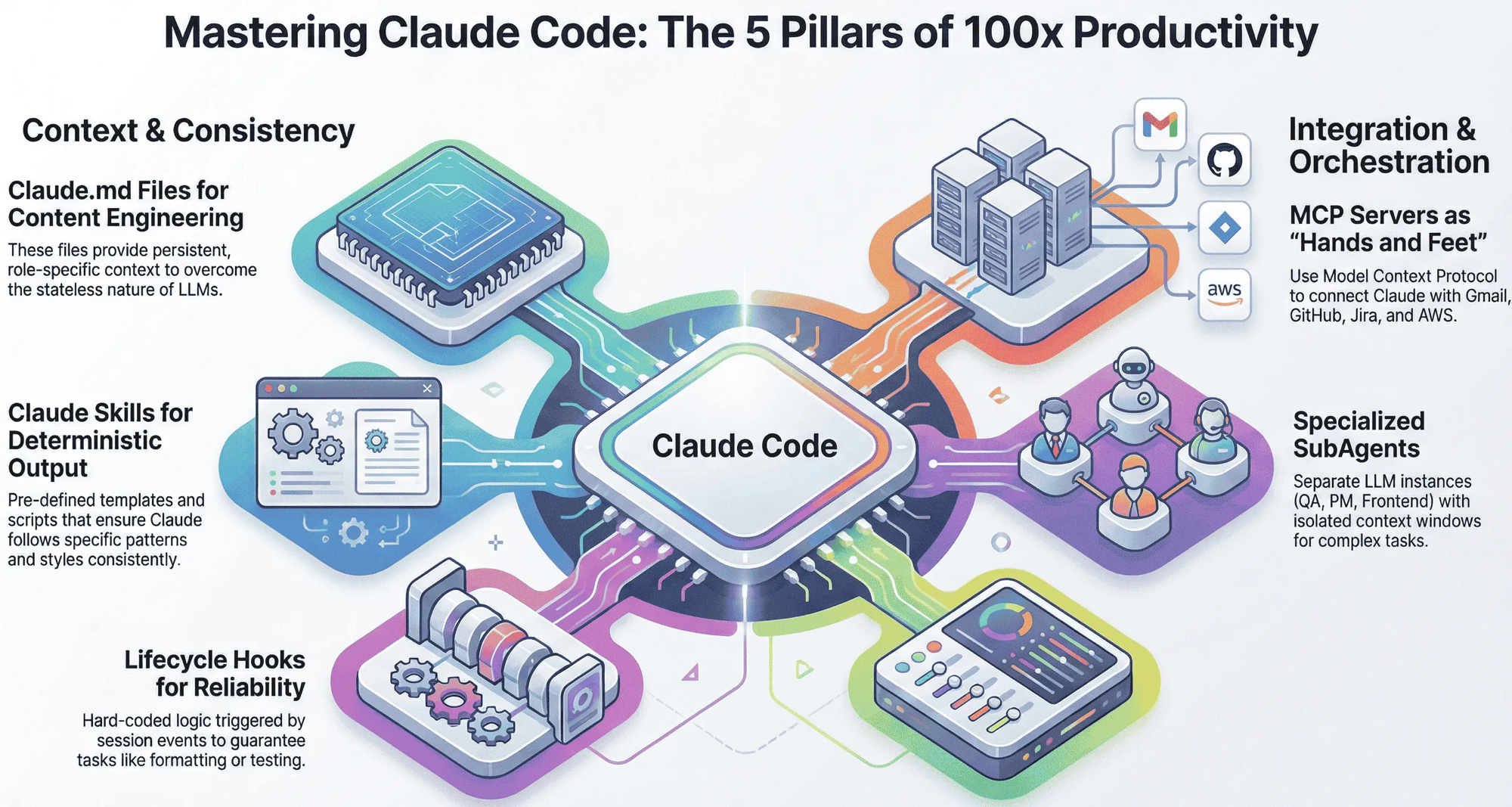
I was also using Claude Code to help me on the development side, simply by giving plain prompts to the Vanilla Claude Code. Obviously, It 10-xed my productivity, but then I saw some people building things at 100x.
I was astonished to see that for them, each and everything was well connected together and Claude Code was handling them like an orchestrator and they left the Claude Code screen the whole day and even though they don't call Claude Code, rather Claude Code calls them to tell and ask certain things on Gmail and even WhatsApp.
I got goosebumps, so I started researching it. Here are the five things I figured out they were using and I was missing:
1. Claude.md Files
After spending years with LLMs, I learnt one thing: LLMs are jack of all trades, they are adaptable, they have everything for us we can't even imagine, but the issue is that they are stateless — they don't remember.
So to make them master of one thing, to make them adapt to some specific role, to make them do unimaginable things for us: All we need is Content Engineering.
And as these coding agents like Claude Code are built on top of LLMs, so Content Engineering is very important for them.
And these Claude.md files actually serve for this Context Engineering task.
2. Claude Skills
Another bad habit of LLMs, they are non-deterministic. Every time they do things in a new style. Every time a new plan for implementing a feature, a new project structure, a new way of formatting the git commit message, or a new style of writing an email.
This problem is solved by Claude Skills.
Everything you think that should be done in a specific pattern and style, instead of saying it again and again to Claude, you have to create a Claude Skill. Actually, this is also Context Engineering.
Here you provide the context about the patterns, styles, scripts, templates and plans to do some specific task.
3. MCP Servers
Another Abnormality with LLMs, this one is by birth. They are handicapped and severe introverts. It has got brain, but no hands or feet to do any task. And as it is soo introvert so it doesn't talk to the world on its own.
So Here MCP Servers Rescue them to give them hands and feet and provide them a easy protocol to talk to the world.
So Through MCP Servers, we can connect the Claude Code with all the third-party systems and SAAS apps and make them take actions in different different apps.
Imagine we connected: Gmail, WhatsApp, Jira, GitHub, Jenkins, AWS, Notion and many more connected via MCP with Claude Code, and we can control them from a centralized interface…
Thanks to MCP, BTW, MCP was also introduced by Anthropic, the same as Claude Code.
4. SubAgents
Now my dear LLMs have another bad habit…Opphhhhoooo…
They have a limited context window. You can provide context via Claude.md and Skills, but you also have to make sure that this context fits in the window…
And that is also one way or the other connected to context engineering, how to make the trade-off between telling it everything, and it should also fall within the limit.
And that's why LLMs do best one thing at a time, and so does Claude Code.
And here Subagents come in to rescue us. You may think of Subagents as separate instances of an LLM or Claude Code, which have their own isolated context window and its own separate Skills and MCP Servers.
There would be separate frontend and backend sub-agents, which would have got their own skills. Then we may have a project manager expert who is connected to all the MCPs and Skills to manage the project, move tickets, and send emails to stakeholders. We may also have a QA subagent who tests everything through the browser automation, MCPs, and respective skills.
One subagent would have all the skills to manage the Frontend Development, another one would have the respective skills and be the backend expert.
5. Hooks
This one, Hooks, is also there to help us with another problem with LLMs.
They don't guarantee anything.
You hope Claude will remember to format code before editing, run tests after changes, follow specific naming conventions, log different activities happening to execute a specific plan. But it doesn't guarantee it.
For some things, you can give control to Claude, but for some sensitive things, you want the control yourself and want to define some hard-coded logic.
That's where Hooks help us, using Hooks we can listen to different events in the lifecycle of Claude Code (session start, session end, tool use, tool output, prompt submit, etc..).
Muhammad Zain Attiq
Agentic AI Engineer • AI Agents • Freelancer